Operating depth
100 m
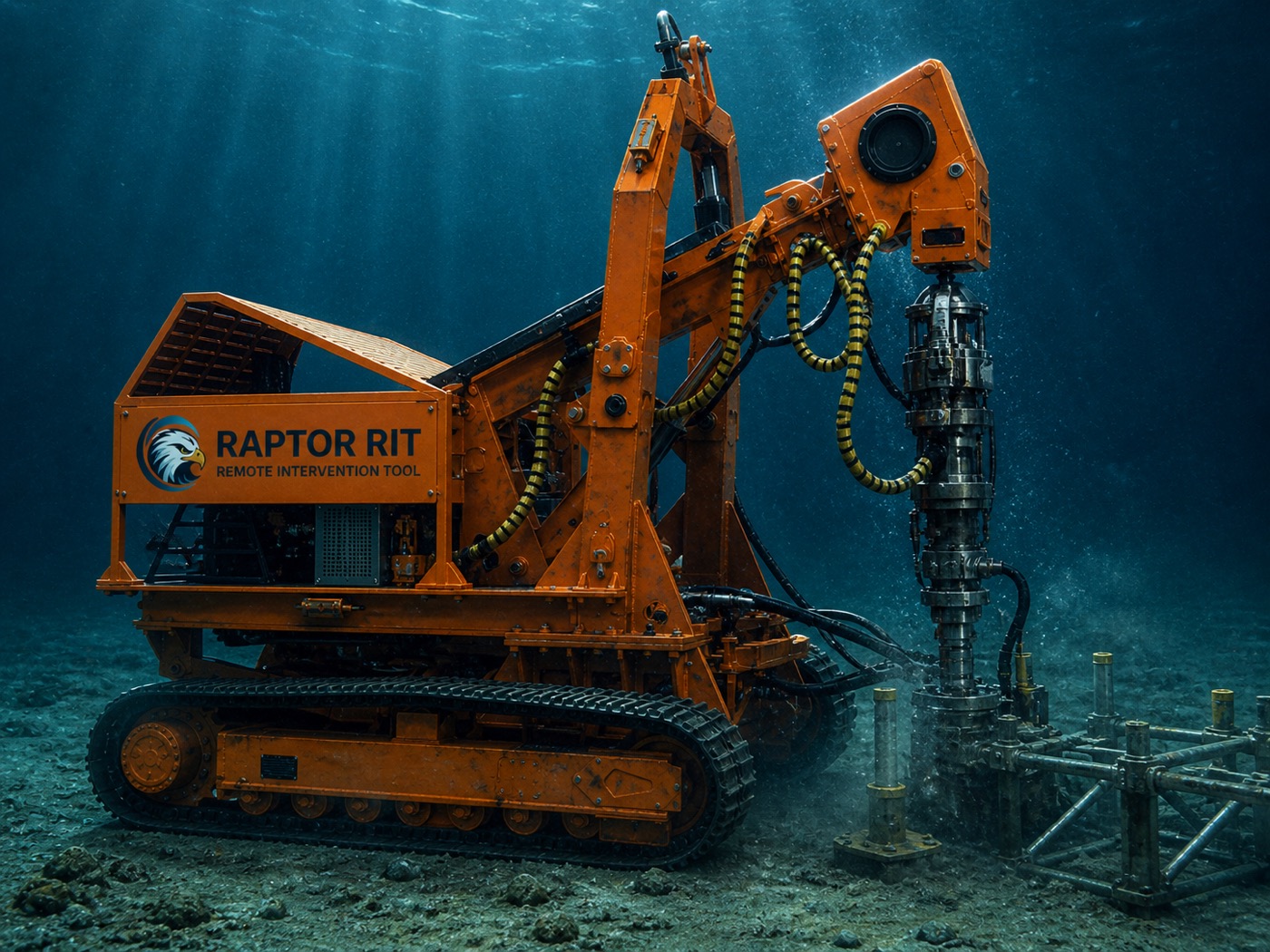
A tracked subsea vehicle that takes intervention and seabed work to depth without a dive team or a full ROV spread.
Raptor’s RIT is a multifunctional crawler platform that works directly on the seabed. It delivers intervention scopes without the conventional ROV spread or diver support those tasks have traditionally required.
Manipulation, tool interfaces, cameras, sonar and anchor gripping are all built into the one vehicle. That combination covers a broad span of work scopes, from survey and inspection through to anchor handling and routine maintenance.
Its logistical footprint is small next to that of older, heavier spreads, which matters on nearshore renewables, offshore wind and the tidal projects now coming forward. That fits where the industry is heading: fewer people offshore, lower vessel and running costs, and more choice in how an intervention campaign is put together.
Tracked running gear, giving the crawler a stable base on the seabed.
Anchor gripping that holds the vehicle securely onto components.
A Schilling Orion 7 RE manipulator arm, or equivalent, to carry out intervention tasks.
A 240 V, 13 A supply feeds tool hydraulics at 33 kW, 60 LPM and 207 bar.
Gemini 720id sonar or similar, with several cameras, pan & tilt included, for navigation and supervision.
Rated for operating depths of up to 100 metres.
Anchor tensioning tools (ATT) can be connected and run from the vehicle at a rated pretension of 100 t. Installation and maintenance scopes on offshore wind farms are a core use, and the onboard cameras and sensors also suit survey and inspection. Taken together, the RIT offers a lighter, lower-cost route to seabed work: a flexible, plug-and-play approach to remote operations that supports the energy transition while reducing the environmental footprint of subsea activity.
| Length (Operating) | 4.3 m |
| Width (Operating) | 2.2 m |
| Height (Operating) | 2.9 m |
| Height (Transport) | 2.2 m (20' ISO) |
| Weight (in Air) | 5.2 t |
| Operating Depth | 100 m |
| Design Depth | 1000 m |
| Max. Seabed Slope | 20° |
| Rated Driving Speed | 1 m/s |
| Pitch Capability | +/- 12° |
| Roll Capability | +/- 12° |
| Rated Pretension Load | 100 t |
| Max. Setting Torque | 1 kNm |
| Design Hex Size | 260 mm A/F |
| Rated Lift Capability | 1 t @ Max Jib |
| Max Crane Height | 3.4 m * |
| Max Jib | 1.5 m |
| Crane Boom Range | +28° / -18° |
| Slew Range | +/- 19° |
| Peak Hydraulic Demand | 33 kW |
| Rated Hydraulic Flow | 60 LPM |
| Rated Hydraulic Pressure | 207 bar |
| Electrical Power Input | 240 V, 13 A |
| Oil Type | Biodegradable |
| Spare Hydraulic Functions | 2 |
| Manipulator Arm | Schilling Orion 7 RE |
| Fixed Cameras | 3x LUXUS PUR SD |
| Lights | 3x Bowtech LED K-Series |
| Pan & Tilt Cameras | 2x Spyball SSB-HD |
| Sonar | Gemini 720i (pan + tilt) |
* Max crane height is taken from the seafloor up to the fleeting mechanism.
Reduced personnel exposure offshore, at lower operational cost.